Over the past few years, the travel connectivity market has become more fragmented. A traveler no longer chooses only between roaming and a local SIM card. The market now includes app-based eSIM marketplaces, unlimited-data offers, regional bundles, and services built around different assumptions about how people use mobile internet abroad. That shift has changed the logic of comparison: the question is no longer whether eSIM works in principle, but which provider matches the trip length, destination, device, data needs, and tolerance for setup friction.
Airalo, Holafly, Nomad, Yesim, and other services are built on the same basic technology, but they solve different problems. Some are stronger on catalog breadth, some on simplicity, some on data volume, and some on price flexibility. The market may look similar on the surface, yet the practical experience can differ sharply from one country to another.
This review compares the main product models, pricing logic, service structure, and the limitations that matter in real travel conditions. The goal is not to name a universal winner, but to show where each service fits best and where travelers are most likely to make a poor choice.
How the travel eSIM market has changed
The biggest structural change is that eSIM has moved from a niche feature to a mainstream travel product. That happened because three things matured at the same time: eSIM-compatible smartphones became common, travel-tech platforms learned how to distribute digital plans at scale, and consumers became more comfortable buying connectivity through apps rather than at airport kiosks or telecom stores.
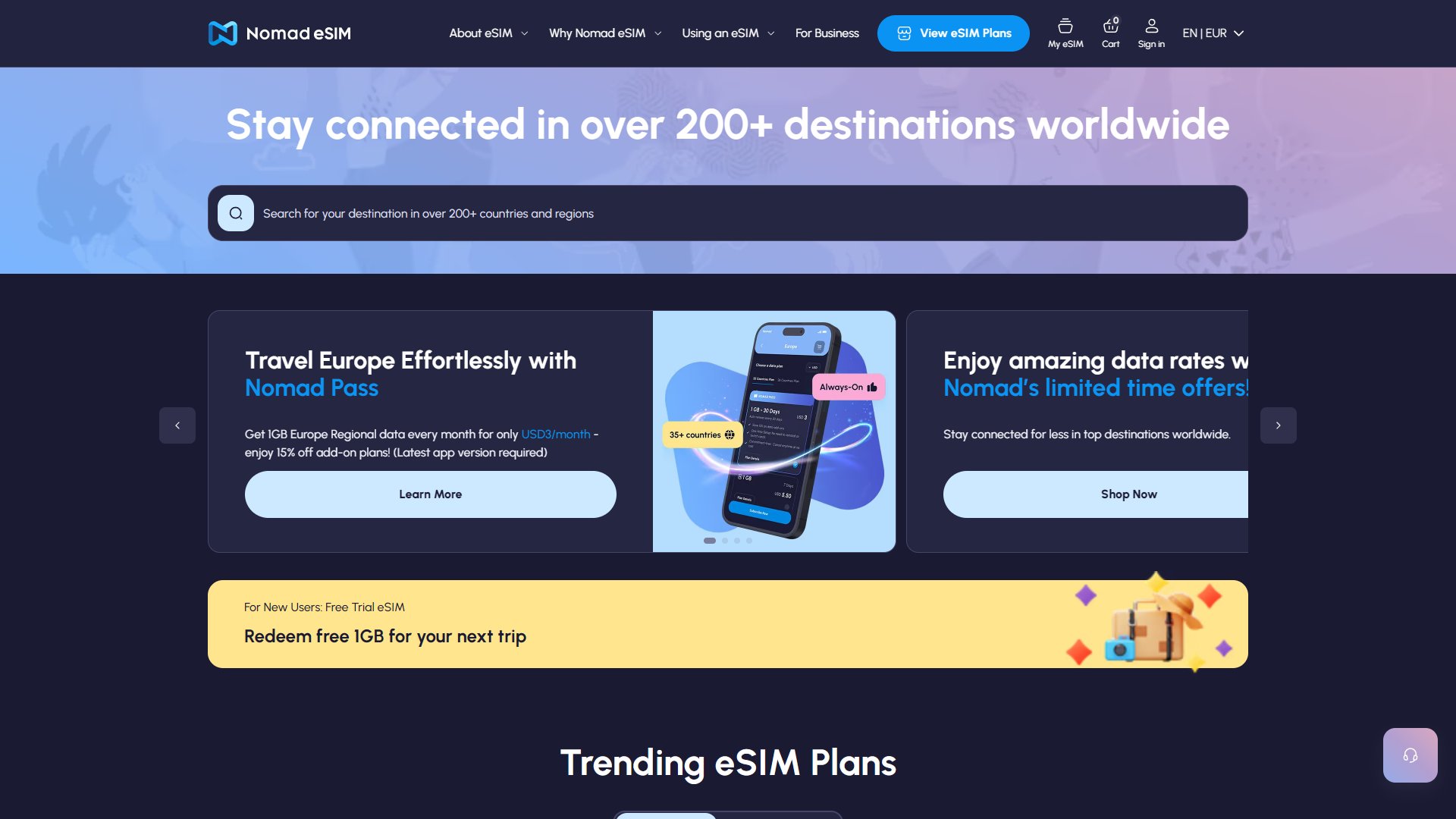
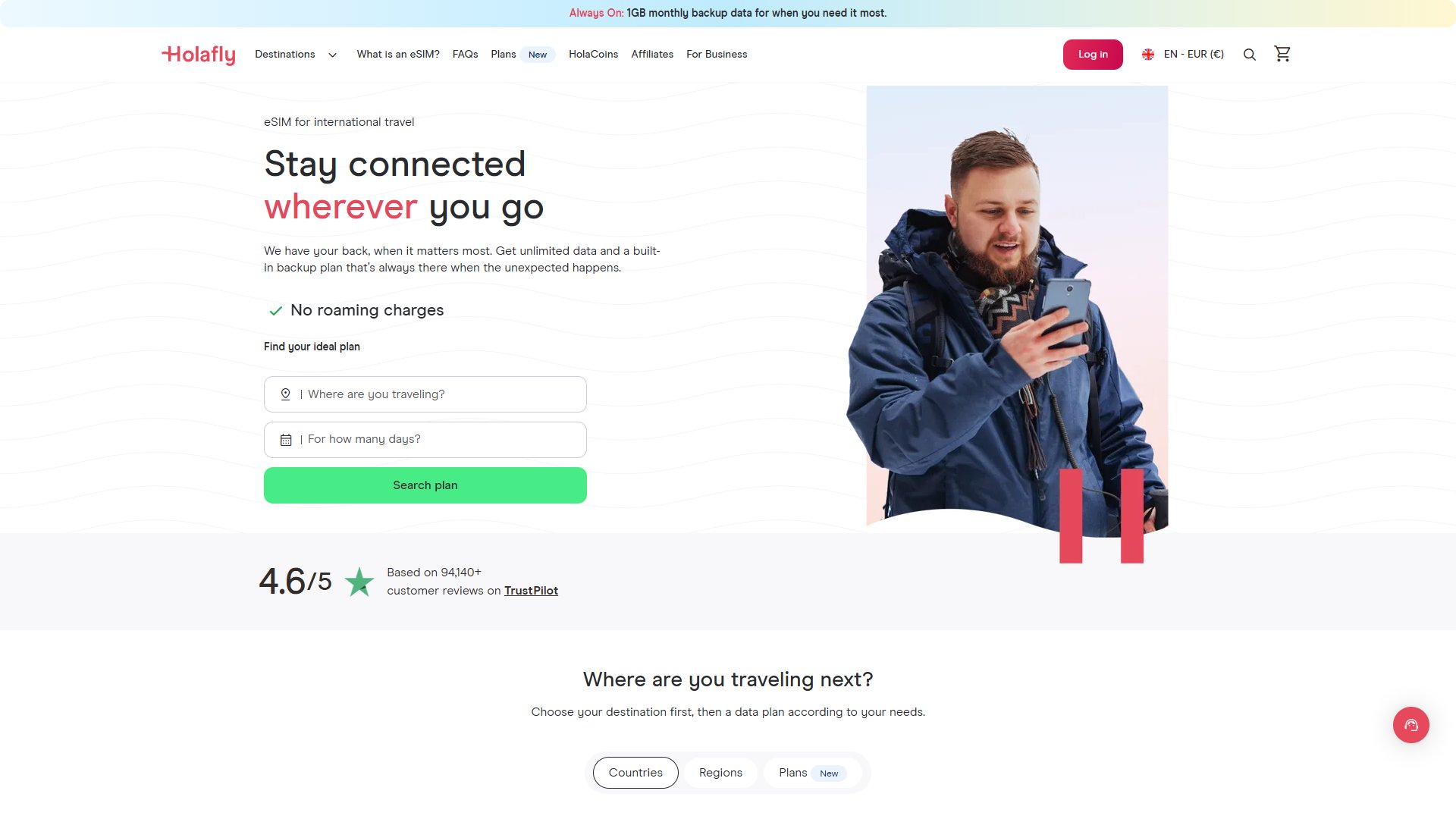
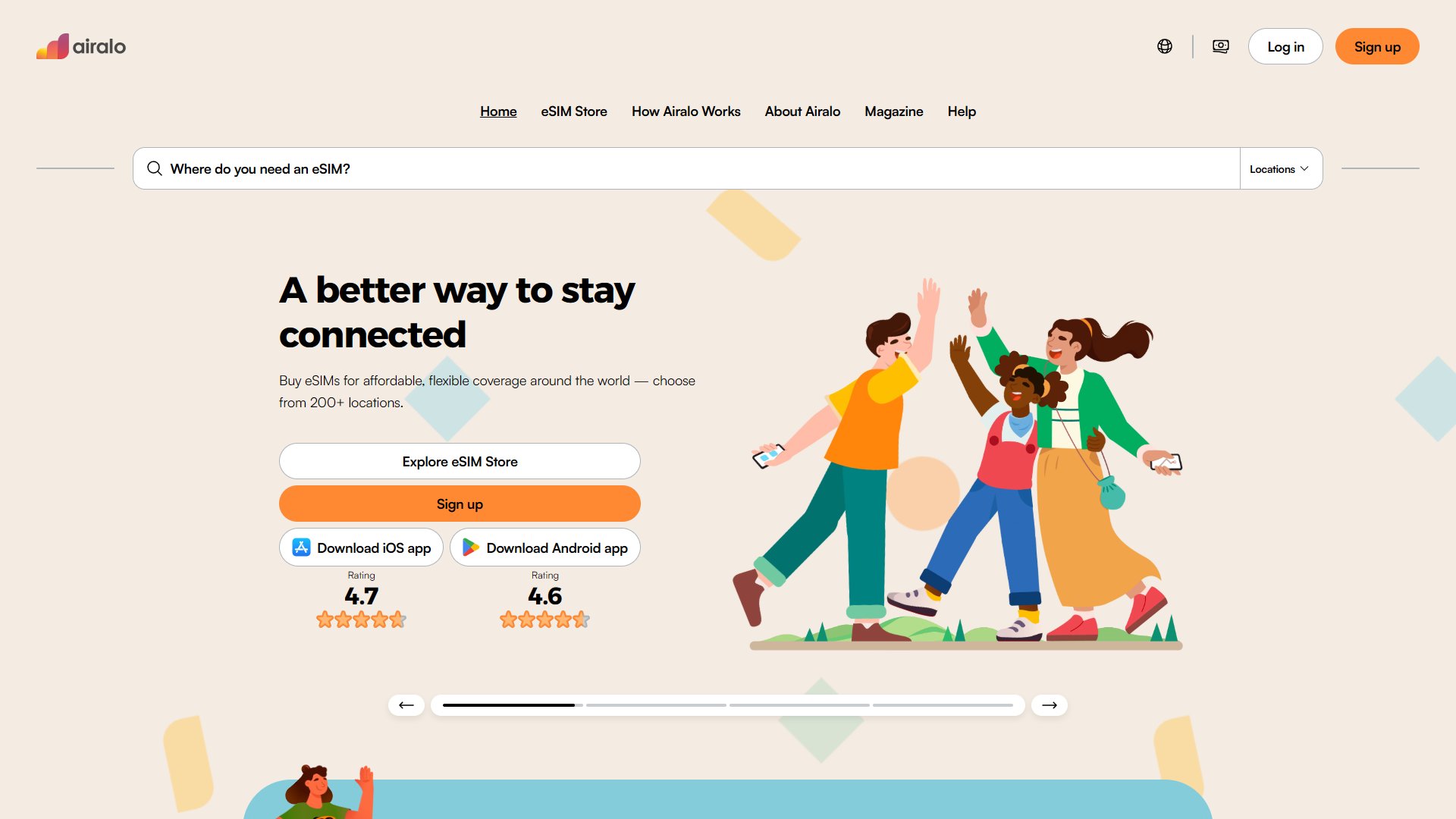
As a result, the market split into recognizable product models. Airalo became a benchmark for broad marketplace coverage. Holafly built a strong position around unlimited-data plans and service-led positioning. Nomad established itself as a clean, app-first alternative with straightforward prepaid bundles. Yesim occupies a similar digital-first segment, with country, regional, and global plans. Other services fill narrower niches, often by geography, price, or support model.
The practical takeaway is simple: the “best” service depends less on brand reputation alone and more on whether the traveler needs a few gigabytes for maps and messaging, or a much heavier data package for work, navigation, video calls, and constant app usage. The market has become more specialized, not less.
Why the topic matters now
For international travel, connectivity is no longer a convenience layer. It is part of the trip infrastructure. Boarding passes, ride-hailing, hotel check-in, translation tools, banking confirmations, and navigation all depend on having data when you land. This makes the choice of provider operational, not cosmetic.
The practical issue is that eSIM products can look interchangeable until the traveler compares the details: whether the plan is data-only, whether activation is immediate, whether top-up is possible, whether the plan is country-specific or regional, and how much the final cost changes when the trip extends by a day or two. In other words, the market rewards careful reading of the terms.
The wrong choice is usually not catastrophic, but it can be expensive or inconvenient. A plan that looks cheap per gigabyte may be poor value if it expires too quickly. An unlimited plan may be more expensive than needed. A flexible regional bundle may be the most rational option for a multi-country itinerary.
How travelers choose today
Travelers do not all choose eSIM in the same way. What has changed is the structure of the decision. The first filter is device compatibility. The second is trip format. The third is data usage. Only after that do travelers compare price and brand.
This is visible in how the leading providers design their products. Airalo offers a wide catalog because the market rewards destination coverage. Holafly emphasizes simplicity and unlimited data because some travelers would rather avoid calculating usage. Nomad and Yesim focus on straightforward app-based purchase flows and multiple plan sizes because many customers want a clean prepaid experience without telecom complexity.
The best eSIM is often the one that reduces uncertainty before departure. A traveler on a three-day city trip has very different needs from a remote worker spending two weeks across several countries. The market now reflects that difference much better than it did a few years ago.
Which approaches work today
In the current market, four approaches are the most relevant. The first is the marketplace model, where the provider aggregates many destination plans and makes them easy to buy in one app. Airalo is the clearest example. The second is the unlimited-data model, where the service reduces decision friction by selling a simple promise. Holafly is the strongest example here. The third is the flexible prepaid model, where the user chooses between local, regional, and global plans. Yesim and Nomad fit this logic well. The fourth is the niche model used by smaller services that compete on a narrow geography, local pricing, or a specific support model.
The marketplace model works best when the traveler values choice and destination coverage. The unlimited model works best when the traveler wants predictability and expects heavy usage. The flexible prepaid model works best when the itinerary is not fully fixed, or when the traveler wants to balance cost and convenience. The niche model can be attractive, but only if the service has strong coverage in the intended destination and transparent terms.
No provider is universally optimal. The market is now segmented enough that the correct answer depends on the trip itself.
What is becoming outdated
Several older assumptions no longer hold. The first is that roaming is always the simplest option. For many destinations, it is now simply the least efficient one. The second is that a physical SIM is automatically safer than an eSIM. In practice, the risk profile depends more on device compatibility and plan terms than on the format itself. The third is that all travel eSIMs are the same product with different logos. They are not.
What is also becoming outdated is the idea that the cheapest plan is the best plan. On paper, a low-cost bundle may look attractive, but if it has a short validity period, weak support, or poor local network performance, the real cost can be higher. The market is moving away from pure price comparison toward value comparison.
Travelers who compare only the headline price often end up paying for redundancy. The better approach is to compare price, duration, destination coverage, and expected data consumption together.
Common mistakes when choosing an eSIM
The most common mistake is buying by brand familiarity alone. A provider can be excellent in one country and merely average in another, because the final user experience depends on local network partners. Another mistake is ignoring whether the service is data-only. For many travelers that is fine, but for others it creates a gap if they still need voice or SMS access.
A third mistake is underestimating setup friction. Even a good eSIM can fail to install cleanly if the device is locked, incompatible, or not updated. A fourth mistake is choosing an unlimited plan for a trip that requires only light usage. In that case, the traveler pays for convenience that may never be used.
The best way to avoid disappointment is to check device support, destination coverage, plan validity, and support channels before purchase. Those four factors matter more than marketing language.
How to evaluate the main services
To compare Yesim, Airalo, Holafly, Nomad, and other services fairly, it helps to use a practical framework rather than a promotional one. The most useful criteria are destination coverage, pricing structure, ease of activation, data model, support quality, and flexibility for trip changes.
Airalo is strongest when breadth matters. Holafly is strongest when simplicity and heavier data use matter. Nomad is attractive for travelers who want a clean, app-based prepaid experience. Yesim is competitive in the same convenience-driven category, with local, regional, and global plans. Other services can be compelling if they are especially strong in one geography or offer a better deal for a specific itinerary.
The market is competitive enough that smaller services can win on narrow advantages. But the leading four remain the most useful reference points because they represent the main product models in the category.
Comparison by use case
Because the market is segmented, the most honest comparison is by use case rather than by a single universal score. The table below reflects the most common travel scenarios.
| Use case | Best fit | Why it fits | Main limitation |
|---|---|---|---|
| Short city trip | Airalo, Nomad, Yesim | Flexible small bundles, easy activation, wide destination options | Data-only plans may not suit voice-heavy users |
| Heavy data usage | Holafly | Unlimited-data positioning reduces the need to monitor usage | Usually higher price and plan conditions |
| Multi-country itinerary | Airalo, Yesim, Nomad | Regional and global plans simplify travel across borders | Regional coverage still needs verification by country |
| Price-sensitive trip | Airalo, Nomad, some local competitors | Fixed-data bundles can be efficient for light usage | Cheapest plan is not always the best value |
| Low-friction setup | Holafly, Airalo | Strong consumer onboarding and clear product messaging | Setup still depends on device compatibility |
The comparison changes when the trip changes. A service that is ideal for a week in one country may be less suitable for a three-country route or a month-long stay.
Comparison of Yesim, Airalo, Holafly, Nomad and other services
Airalo is one of the most established marketplace-style brands in the category. Its advantage is catalog breadth and a familiar app-based purchasing flow. The trade-off is that quality still depends on destination-specific carrier partnerships, which is true for the entire segment but especially visible in a marketplace model.
Holafly stands out because its communication is built around unlimited data. That is a clear message for travelers who do not want to calculate usage or worry about running out of data mid-trip. The downside is that unlimited plans are usually priced at a premium, and the actual terms still matter.
Nomad is a practical, app-first alternative with flexible prepaid plans. It does not dominate the conversation the way Airalo or Holafly sometimes do, but it fits well for travelers who want a straightforward digital purchase flow and do not need a complicated product stack.
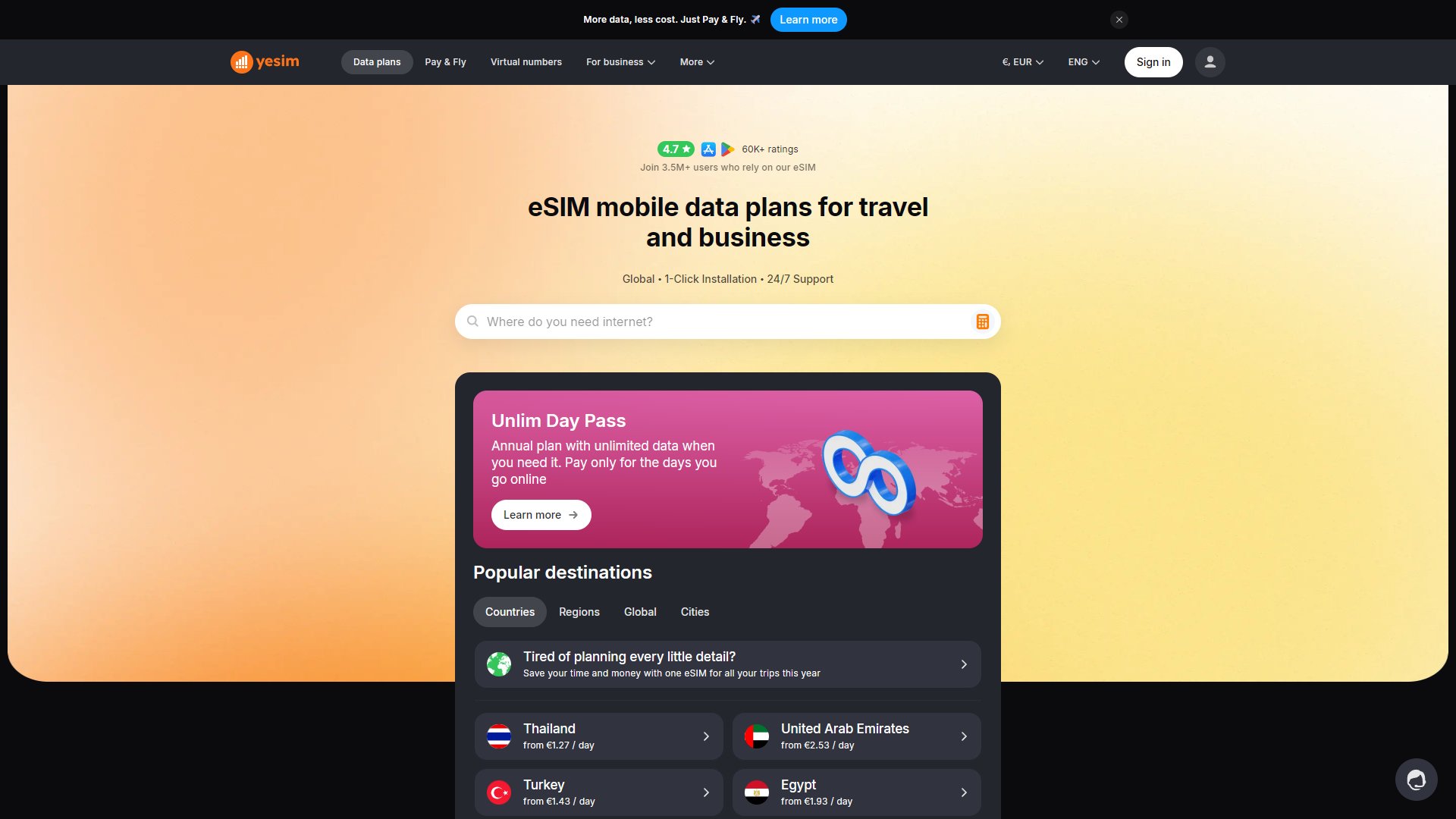
Yesim sits in the same convenience-oriented segment, with country, regional, and global plans and app-based management. User feedback in this category is usually mixed in a familiar way: many travelers value easy activation, while occasional issues can arise with connectivity, compatibility, or support responsiveness.
Other services can be attractive when they are optimized for a specific region, a specific price point, or a specific support promise. They are worth considering, but only if the traveler has checked that the plan structure is genuinely better, not just differently branded.
The market is competitive enough that smaller services can win on narrow advantages. But the leading four remain the most useful reference points because they expose the main product models in the category.
Price: what actually matters
Price comparison in travel eSIM is often misleading if it stops at the headline number. The real metric is effective cost per day or per usable gigabyte. A cheaper plan with a short validity window can be worse than a slightly more expensive plan that gives the traveler enough time to use it properly. The same is true for regional bundles: they may look expensive until compared with the cost of buying separate country plans.
Holafly is usually the premium option in this group because the product is structured around unlimited data. Airalo often looks more affordable in smaller bundles. Nomad and Yesim are competitive in the middle of the market, depending on destination and package size. Other services may undercut them in specific countries, but that advantage is often local rather than general.
The right price comparison is itinerary-based. A traveler should compare the total cost of the trip, not the sticker price of one plan.
Market comparison at a glance
| Service | Approach | Coverage | Typical user | Limitations |
|---|---|---|---|---|
| Airalo | Marketplace-style eSIM catalog | Broad local, regional, and global coverage | Travelers who want choice and wide destination support | Data-only in many plans; quality depends on local partner network |
| Holafly | Unlimited-data travel eSIM | Wide coverage in many destinations | Heavy data users and travelers who want simplicity | Usually premium pricing; usage conditions may apply |
| Nomad | App-first prepaid eSIM | Country, regional, and multi-country plans | Travelers who want a clean, flexible digital product | Data-only focus; local network variability |
| Yesim | Travel eSIM with flexible plan types | Local, regional, and global plans | Users who want app-based convenience and plan variety | Support and performance can vary by destination |
| Other services | Niche or region-specific offers | Often narrower, sometimes stronger locally | Travelers with a specific route or local price advantage | Coverage and support can be less predictable |
Cases based on real travel needs
Consider a traveler flying to Japan for four days. The main need is maps, ride-hailing, restaurant search, and messaging. In that case, a small fixed-data bundle from Airalo, Nomad, or Yesim may be enough. Paying for unlimited data would be unnecessary unless the traveler also streams heavily or works online all day.
Now consider a traveler spending two weeks across Spain, France, and Italy. A regional plan becomes more rational than buying three separate country packages. Here, Airalo, Yesim, and Nomad become especially relevant because their regional structures reduce administrative friction.
Finally, consider a traveler who expects to work remotely from the road, join video calls, and use mobile internet as a primary connection. In that scenario, Holafly’s unlimited-data positioning becomes more compelling, even if the price is higher.
The best eSIM is the one that matches the trip model. The market rewards specificity.
Risks and limitations
The biggest risk in this market is overgeneralization. A service can have strong reviews in one country and weak performance in another. That is not necessarily a product failure; it is a consequence of roaming and carrier partnerships. The second risk is device incompatibility. Not every phone supports eSIM, and not every device is unlocked. The third risk is assuming that a plan’s name tells the whole story. “Unlimited” does not always mean unrestricted in the everyday sense, and “regional” does not always mean every country you expect is covered.
There is also a support risk. Digital-first services are efficient, but if something goes wrong right before departure, the traveler may depend on chat support, email, or self-service troubleshooting. That is acceptable when the product is simple, but it becomes difficult when the user is already at the airport or abroad.
The safest purchase is the one made with enough time to test installation before the trip begins.
FAQ
Which is the best eSIM for travel overall?
There is no single best provider for every trip. Airalo is often the broadest benchmark, Holafly is the strongest unlimited-data option, and Nomad and Yesim are practical alternatives for flexible prepaid travel use.
Is unlimited data always better?
No. Unlimited plans are useful for heavy usage, but they can be more expensive than needed for light travel. For short city trips, a fixed-data plan is often more efficient.
Are all travel eSIMs data-only?
Most major consumer travel eSIMs are data-only. That is normal in this segment. Travelers who need voice or SMS should check the plan terms carefully.
Can I use one eSIM across multiple countries?
Yes, if the provider offers regional or global plans. Airalo, Yesim, Nomad, and Holafly all have versions of this structure, though coverage should still be checked country by country.
What is the main hidden risk?
The main risk is assuming the product will behave the same everywhere. In reality, local network quality, device compatibility, and plan conditions shape the experience more than the brand name alone.
Conclusion
The travel eSIM market is no longer a simple race to the cheapest data plan. It is a layered market with different product philosophies: broad catalog access, unlimited-data simplicity, flexible prepaid bundles, and niche local offers. That is good news for travelers, because it means there is now a service for almost every trip pattern.
If the trip is short and data needs are moderate, Airalo, Nomad, and Yesim are often practical starting points. If the trip is data-heavy and convenience matters more than price, Holafly becomes more attractive. If the route is unusual, the best answer may be one of the smaller services with stronger local coverage or better regional pricing.
In other words, the right way to choose the best eSIM for travel is to treat it like a travel infrastructure decision, not a consumer gadget purchase. Compare the route, the data load, the validity period, and the support model. The market is mature enough now that the details are where the real value sits.